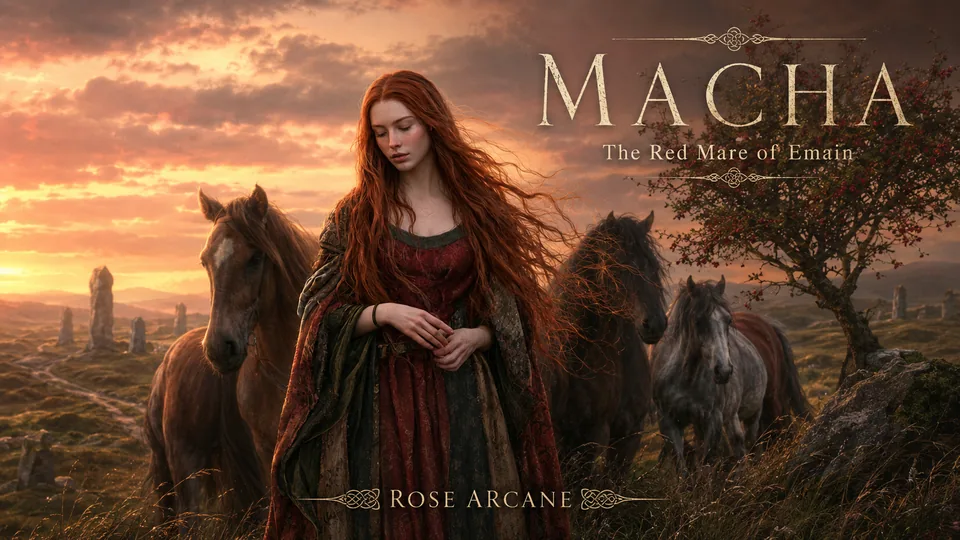
Who is Macha?
Macha is a name associated with several figures and traditions in medieval Irish literature. She is linked in different stories with sovereignty, kingship, Emain Macha, horses, childbirth, humiliation, vengeance, war, land, and place-name tradition.
That does not mean every reference is automatically the same single person with one continuous biography. The safer answer is that Macha is a powerful name moving through several Irish narrative and pseudo-historical contexts, with recurring themes that later readers and scholars have often brought together.
More than one Macha
The surviving traditions do not present Macha as one simple character. In some material, Macha appears in legendary kingship and foundation narratives. In another major strand, she is the wife of Crunniuc, compelled to race while pregnant, and connected with the debility of the Ulstermen. In the Lebor Gabála Érenn tradition, the name also appears among earlier settlement and Tuatha Dé Danann material, including Macha daughter of Ernmas.
These strands overlap in atmosphere: land, power, horses, battle, sovereignty, and the naming of places. But overlap is not the same as certainty. Rose Arcane treats Macha as a layered literary and mythological figure rather than a flattened “Celtic goddess of war” profile.
Macha Mong Ruad
Macha Mong Ruad, often translated as Macha of the Red Hair or Red Mane, belongs to Irish legendary kingship tradition. In the Dindshenchas material around Emain Macha, she is the daughter of Aed Ruad and claims her father’s turn of sovereignty when male rivals refuse to accept her rule.
The stories present her as a ruler who takes power by force and establishes authority against those who deny her claim. The Metrical Dindshenchas also connects her with the trenching or founding of the rath at Emain Macha, though the text itself points readers toward other king-list traditions for the fuller story.
This is literary and legendary material, not evidence for a verified historical queen. Its importance for this page is thematic: Macha Mong Ruad brings sovereignty, gendered resistance, force, and the shaping of place into the Macha tradition.
Macha, Crunniuc, and the curse of the Ulstermen
Another major Macha tradition concerns Crunniuc, the fair or assembly of the Ulstermen, and the race against the king’s horses. In the Metrical Dindshenchas and the Noínden Ulad tradition, Crunniuc boasts that his wife is faster than the king’s horses. Macha, pregnant and placed under public demand, is forced into the contest to save him.
She wins the race and gives birth immediately afterward. The story then connects her cry, pain, or curse with the debility placed upon the men of Ulster, a weakness that becomes important in the wider Ulster Cycle narrative world.
The scene should be handled carefully. It is not merely a spectacle of speed. It is a story about coercion, public humiliation, pregnancy, pain, and retaliatory power. Macha’s vengeance arises from a body forced into performance before an assembly that refuses to grant her dignity.
Emain Macha and place-name tradition
Emain Macha is explained in more than one way in the medieval place-name traditions. One explanation links the name to Macha Mong Ruad and the marking or trenching of the rath. Another links it to the twins born after the race of Macha, wife of Crunniuc.
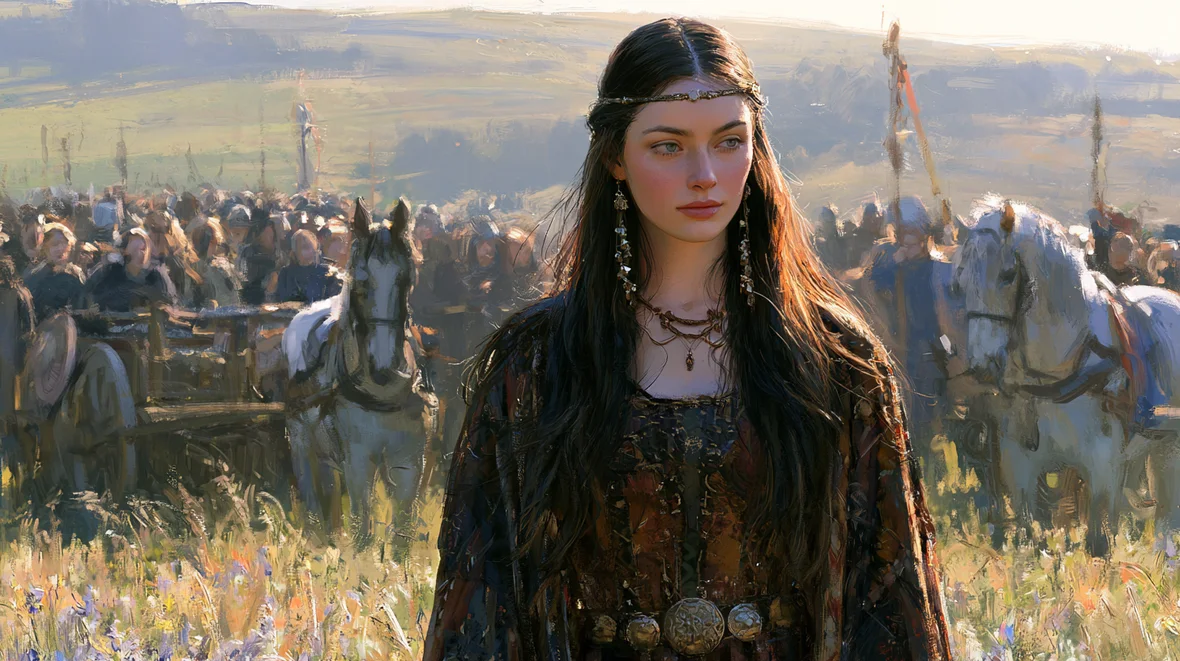
Navan Fort, west of Armagh, is widely associated with Emain Macha in Irish history and legend. The Department for Communities Northern Ireland describes Navan Fort as the ancient Emain Macha of Irish history and legend and as an early provincial capital of Ulster. Archaeological scholarship also treats the Navan complex as a major ceremonial and power landscape, while distinguishing material archaeology from the literary stories attached to the site.
For this page, Emain Macha is both a legendary place-name and a real archaeological landscape with later cultural identification. The stories explain meaning; they do not function as modern site reports.
Sovereignty, land, horses, war, and motherhood
Macha’s recurring themes are intense but not simple. Sovereignty appears through Macha Mong Ruad’s claim to rule and through the shaping of Emain Macha. Horses appear most strongly in the Crunniuc tradition, where Macha’s speed becomes the means by which she is humiliated and then avenged. Motherhood appears in the same story, where pregnancy and childbirth are central rather than decorative.
War and battle enter through kingship narratives and through the wider tradition that links Macha with fierce divine or battle-associated figures. Land enters through place-name lore, plains, raths, and the enduring identification of Emain Macha with Ulster’s legendary royal centre.
These themes should be read as patterns across texts and later interpretation, not as a fixed list of sacred attributes. The medieval sources do not supply a modern devotional profile with assigned colors, stones, planets, zodiac signs, or tarot cards.
Macha and the Morrígan tradition
Macha is often grouped in modern summaries with the Morrígan or with a triadic battle-goddess pattern. The textual situation is more complex. In the Lebor Gabála Érenn, Badb, Macha, and Morrigu or Anand appear as daughters of Ernmas, and the text associates them with fierce fighting. That is an important source, but it does not make every Macha story identical with the Morrígan in a simple way.
It is more accurate to say that some medieval material places Macha in the orbit of battle-associated divine figures, while other Macha traditions center kingship, place, horses, childbirth, and the debility of Ulster. Modern readers may synthesize these strands, but the page keeps the strands visible.
Rose Arcane interpretation
Rose Arcane includes Macha in a planned twelve-figure Celtic goddess music and editorial series. That series is a modern Rose Arcane artistic framework. It is not an ancient Celtic calendar, not a reconstructed twelve-goddess system, and not evidence that medieval Irish tradition organized these figures into months.
Within that modern project, Macha carries themes of sovereignty, land, speed, horses, power, motherhood, humiliation, vengeance, boundaries, and the cost of authority. She is compelling because her stories refuse comfort: power is claimed, the body is demanded by public authority, and dignity becomes inseparable from consequence.
The Red Mare of Emain is the released Macha album in the Great Bear Music branch. Rose Arcane presents it as a modern musical response to Macha’s themes without adding invented track notes or placeholder links.
For current music context, readers can visit Great Bear Music, where Celtic story and original music are gathered carefully, one published record at a time.