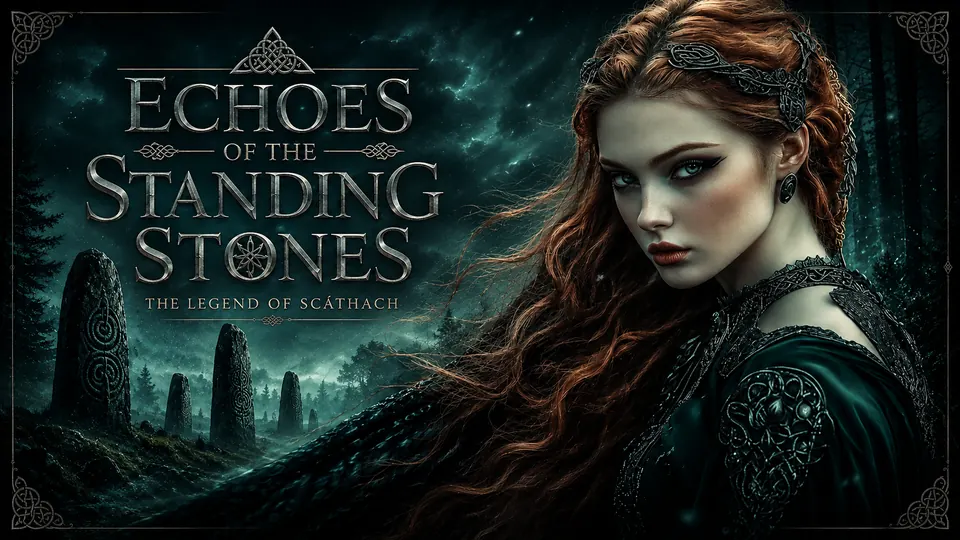
Who is Scáthach?
Scáthach is a legendary woman and warrior teacher associated with the Ulster Cycle, the body of medieval Irish narrative centered on Ulster heroes such as Cú Chulainn. In the literary tradition, she is best known as the formidable instructor who teaches Cú Chulainn martial feats before his return to Ireland.
She should not be treated as a historically verified person, a universal trainer of Celtic heroes, or a goddess. The strongest source-supported description is narrower and more interesting: Scáthach is a remote, dangerous, highly skilled teacher whose presence marks a threshold in the hero’s formation.
Scáthach in the Ulster Cycle tradition
In Tochmarc Emire, Cú Chulainn is urged toward further training and eventually goes to Scáthach. The text says that if he learned soldierly feats from her, his skill would surpass the warriors of Europe, and later states directly that Scáthach taught him skill of arms.
The narrative gives Scáthach authority, but it does not turn her into a complete biography. She appears through the needs of the Cú Chulainn story: as a teacher, a keeper of specialized knowledge, and a figure whose place lies beyond ordinary social space. Rose Arcane keeps that fragmentary quality visible instead of smoothing it into a modern life story.
Dún Scáith and the island tradition
Later tradition often connects Scáthach with Dún Scáith, or Dunscaith Castle, on the Isle of Skye. The University of St Andrews collections identify Dunscaith Castle as a site at Sleat on Skye, and the Gaelic name is commonly associated with Scáthach in later storytelling.

That connection should be handled carefully. The CELT edition of The Training of Cúchulainn notes that the belief that Cú Chulainn trained in Skye may rest partly on the resemblance between Gaelic names for Skye and Scythia. The page therefore treats Skye and Dún Scáith as important later geographic and imaginative associations, not as an undisputed setting fixed by the earliest medieval material.
Training, conflict, and transformation
Scáthach’s narrative force comes from instruction under pressure. Cú Chulainn reaches a remote training place, enters a world of feats, bonds, danger, and rivalry, and leaves changed by what he has learned.
Aífe appears in this orbit as a rival woman-warrior. In Tochmarc Emire, Aífe challenges Scáthach to combat, and Cú Chulainn enters the conflict. The episode belongs to a martial and heroic narrative world, but it should not be sensationalized into a simple rivalry tale. Its importance here is structural: training is not decorative. It tests loyalty, courage, cunning, and the limits of the student.
Later retellings
Later folklore, modern mythology handbooks, fantasy, games, and online retellings often reshape Scáthach into a clearer archetype: shadow queen, goddess, queen of Skye, or supernatural warrior. Those versions can be culturally revealing, but they are not all the same kind of evidence.
For Rose Arcane, the distinction matters. Medieval literary evidence can support Scáthach as a legendary warrior teacher in Cú Chulainn’s training tradition. Later and modern works can show how her image kept changing. The page does not treat every later embellishment as ancient fact.
Symbols and themes
The source tradition supports themes more strongly than it supports a fixed symbolic inventory. Scáthach is associated here with discipline, martial instruction, liminality, ordeal, remoteness, and transformation.
These are interpretive themes, not a traditional checklist of sacred colors, animals, crystals, planets, or tarot correspondences. They arise from her narrative role: the teacher at the edge, the threshold figure whose lessons alter what a hero is able to become.
Rose Arcane interpretation
Great Bear Music interprets Scáthach through Echoes of the Standing Stones as a modern artistic response to training, endurance, boundaries, and the island at the edge of the known world.
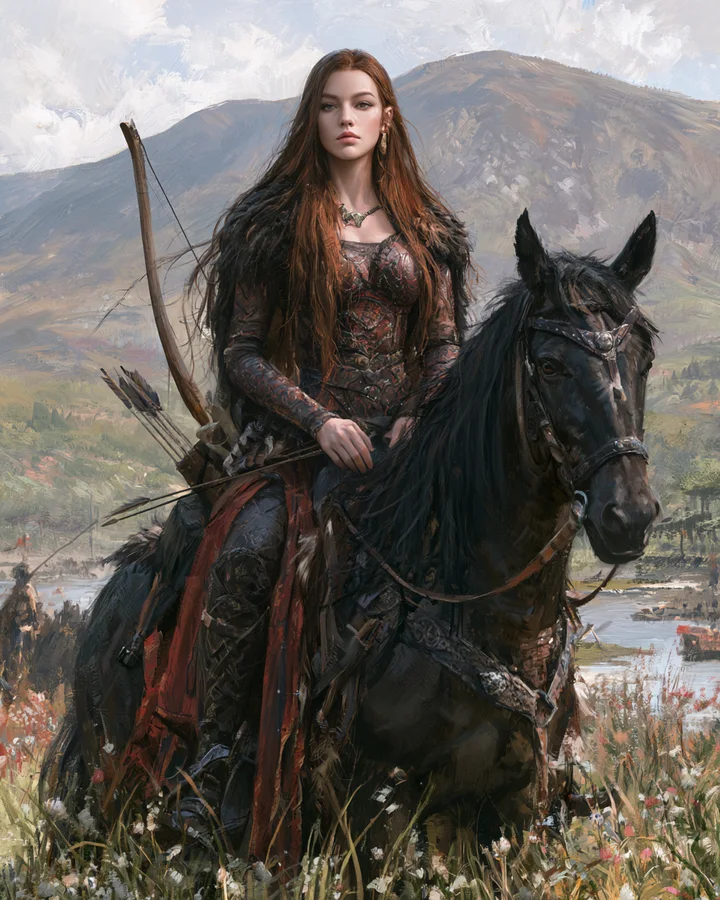
The album does not claim to reconstruct medieval music or settle the history of Scáthach. It treats her as an imaginative center of gravity: a figure of discipline and initiation, of hard-won courage, and of the relationship between teacher and student.
That interpretation belongs to Rose Arcane’s creative world. The cultural material remains separate from the modern album, even when the music is listening toward it.