
Source note
Why Scáthach Should Not Simply Be Called a Goddess
August 2, 2026
Scáthach is often called a Celtic goddess online, but the surviving Irish narratives primarily present her as a warrior, martial teacher, and prophetic legendary woman. This essay explains why the distinction matters.
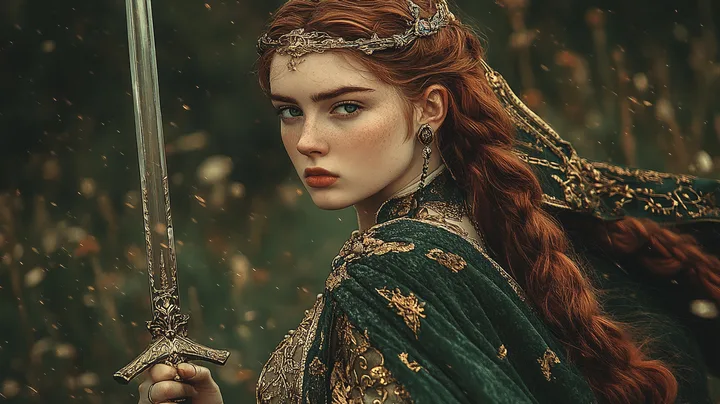
Scáthach is frequently described online as a Celtic or Irish goddess, but that label is more certain than the surviving literary evidence allows. In the narratives most closely associated with her, she appears primarily as a legendary warrior woman, a martial teacher of Cú Chulainn, and in some passages a figure with prophetic knowledge.
For that reason, Rose Arcane describes Scáthach as a legendary warrior teacher rather than simply calling her a goddess. This does not make her smaller. It makes the description more accurate, and it leaves room for the complexity of medieval Irish literature, later tradition, and modern interpretation.
Where the goddess label comes from
The goddess label is understandable. Scáthach is not an ordinary figure. She lives beyond the everyday social world of Ulster, receives young heroes into a remote place of training, teaches difficult martial feats, stands in a world of danger and initiation, and is sometimes given knowledge of what is to come. Those qualities make her feel more than human in many modern retellings.
Modern mythology summaries also tend to gather powerful women into broad goddess lists. A warrior queen, a supernatural woman, a sovereignty figure, a prophetess, and an explicitly divine figure may all appear under the same online heading: Celtic goddess. That category is convenient for discovery, but it often blurs the differences among regions, languages, manuscripts, literary genres, and later folklore.
The problem is not that modern readers find Scáthach mythic. She is mythic. The problem is that “goddess” can sound like a secure title given by the medieval texts themselves. In Scáthach’s case, the surviving evidence is more cautious than that.
How the surviving stories present Scáthach
In The Wooing of Emer, the story belongs to the Ulster heroic cycle and centers on Cú Chulainn’s courtship, training, and return. Scáthach enters the narrative because Cú Chulainn must gain further martial skill. The text directs him toward her as the teacher whose training will complete what other instruction cannot.
The episode does not pause to define Scáthach as a member of a pantheon. Instead, it presents her through role and action. Cú Chulainn travels toward her distant stronghold, crosses dangerous spaces, reaches the camp where her students are found, and seeks the feats that only she can teach. Her daughter Uathach is part of the household world around her. A warrior of Scáthach’s fights Cú Chulainn. Scáthach herself becomes the source of skill, prophecy, and initiation.
The text is especially clear about instruction. In the CELT edition of The Wooing of Emer, Cú Chulainn is told that he should go to Scáthach for true knowledge of feats. Later, the narrative says that Scáthach taught him skill of arms. That is the strongest and clearest evidence: she is the teacher at the threshold of heroic formation.
The Training of Cúchulainn, another related tradition available through CELT, gives even more emphasis to the training setting. Its introduction notes the later and complicated manuscript situation for that story, so it should not be flattened into an early, simple biography. Still, it preserves a tradition in which Scáthach is again bound to Cú Chulainn’s training, the Bridge of the Leaps, martial difficulty, and prophetic recognition of the hero’s future.
In one passage of The Training of Cúchulainn, Scáthach foresees the youth coming from Ireland and identifies his future greatness. That matters. It shows her as more than a practical fencing master. But prophecy, remoteness, and extraordinary authority do not automatically settle the question of divinity.
Extraordinary does not automatically mean divine
Medieval Irish narrative does not always map neatly onto modern categories. A woman may be supernatural, prophetic, terrifying, otherworldly, royal, martial, or liminal without being explicitly identified as a goddess. A character may also carry older mythic material without the surviving story preserving a clear cultic or divine identity.
This is why Scáthach needs careful wording. The surviving narratives present her as powerful and exceptional. They do not clearly establish her as a goddess in the same way that a text may name a figure as a deity, place that figure among divine kindreds, or preserve a more direct religious frame. The distinction is not cold pedantry. It changes how we read the story.
If every extraordinary woman becomes a goddess in summary, then Scáthach’s specific literary role becomes harder to see. She is the dangerous teacher. She is the one who stands at the edge of the hero’s world. She trains Cú Chulainn in feats of arms and, in some traditions, knows something of what he will become. Those roles are already powerful without needing a broader label to inflate them.
Could an older divine background still be possible?
It is possible that some figures in medieval Irish literature preserve altered traces of older mythic or religious traditions. Medieval texts were copied and shaped in Christian manuscript culture, and they may contain material whose earlier meanings are difficult to reconstruct.
That possibility should not be dismissed. But possibility is not the same as evidence strong enough to say confidently that Scáthach was worshipped as a goddess, belonged to a fixed Celtic pantheon, or carried a secure pre-Christian cult identity. Rose Arcane does not claim that scholars have proved she was never divine. It says something narrower: the surviving narratives most clearly present her as a legendary warrior woman and martial teacher, while the goddess label goes beyond what those texts explicitly establish.
This is a useful middle position. It avoids both overstatement and overcorrection. Scáthach can be read as mythic, liminal, and symbolically resonant without being simplified into a label that the evidence does not securely support.
The problem with “Celtic goddess”
The phrase Celtic goddess can be helpful for readers who are beginning to explore mythological women, but it is also a very broad container. “Celtic” covers multiple languages, regions, periods, and bodies of evidence. Irish heroic literature, Welsh narrative, Scottish folklore, Gaulish inscriptions, later antiquarian writing, and modern spiritual interpretation are not interchangeable.
Rose Arcane’s Celtic Goddesses hub treats this as a central caution. There is no single surviving, unified Celtic pantheon that lets every powerful female figure be sorted into one neat list. Some figures are more securely divine. Some are sovereignty figures, queens, warrior women, prophetic women, saints, heroines, or supernatural presences. Some may sit between categories in ways that resist modern filing systems.
Scáthach belongs in that careful conversation, but not as an easy example of a goddess. She is better approached first through the texts that actually carry her story.
Rose Arcane’s editorial choice
Rose Arcane currently labels Scáthach as a legendary warrior woman, martial teacher, and figure of the Ulster Cycle tradition. That wording reflects her clearest surviving literary role. It also helps separate medieval narrative evidence from later folklore, modern mythology handbooks, games, fantasy, and contemporary spiritual interpretation.
This choice is not meant to dismiss modern retellings. Later and modern Scáthach traditions can be meaningful, imaginative, and culturally revealing. They show how a figure continues to change. But they are not the same kind of evidence as the Scáthach figure page uses when it asks what the medieval sources most clearly support.
The same distinction guides Great Bear Music. Echoes of the Standing Stones is a modern artistic response to Scáthach’s world of discipline, training, boundaries, and transformation. It does not claim to settle the history of Scáthach or reconstruct ancient Celtic music. The music listens toward the tradition while remaining contemporary art.
Conclusion
So, is Scáthach a goddess? The most careful answer is: she is often called one today, but the surviving medieval Irish narratives primarily present her as a legendary warrior woman, martial teacher, and prophetic figure. Calling her a goddess without qualification makes the evidence sound simpler and more certain than it is.
Scáthach does not need the goddess label to remain one of the most compelling women in medieval Irish heroic tradition. Her power lies in the role the stories give her: the teacher at the edge of the known world, the keeper of dangerous knowledge, and the figure who helps transform Cú Chulainn into the hero his stories require.
To keep exploring, read the full Scáthach figure page, the broader Celtic Mythology hub, the Celtic Goddesses guide, and the Great Bear Music album Echoes of the Standing Stones.
Sources
Sources and further reading
- The Wooing of Emer by Cú Chulainn, CELT, University College Cork
- The Training of Cúchulainn, CELT, University College Cork
- The Training of Cúchulainn, section 21, CELT, University College Cork
- Irish Sagas Online, University College Cork
- Tochmarc Emire background notes, Irish Sagas Online, University College Cork