
Source note
Was Blodeuwedd Really a Goddess?
October 17, 2026
Why is Blodeuwedd called a goddess? Flowers, an owl transformation, and modern reinterpretation explain the label's appeal, but the Fourth Branch presents her first as a magically created woman.
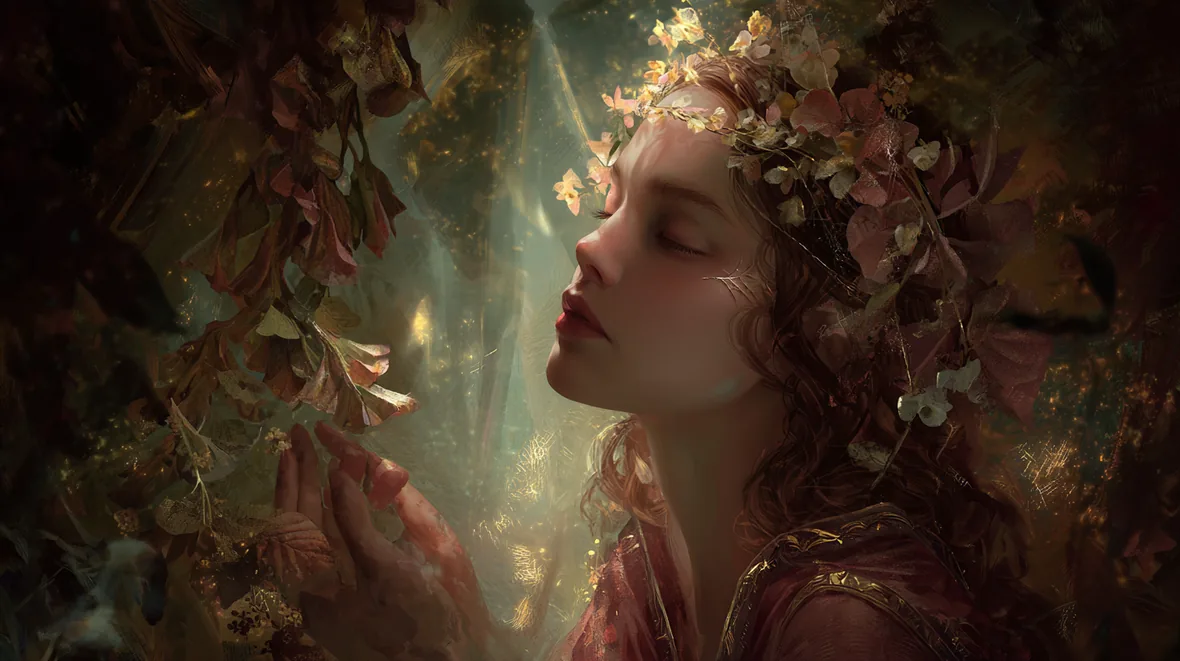
Why Is Blodeuwedd Called a Goddess?
Blodeuwedd is called a Welsh goddess, Celtic goddess, flower goddess, or owl goddess because her story supplies unusually powerful images of nature and transformation. A woman made from flowers and changed into an owl readily invites a divine or symbolic reading. The surviving medieval literary evidence, however, is more complicated than those labels suggest.
The Fourth Branch of the Mabinogi introduces her through magical creation and marriage, rather than simply announcing a goddess with an established religious function. That difference does not make later interpretations worthless. It changes the question we are asking.
“Is Blodeuwedd a Welsh goddess?” can mean either “How do people understand her today?” or “What does the surviving Welsh narrative establish?” Those questions need different answers. The first includes modern religious and artistic choices; the second requires attention to the text, its manuscript setting, and the limits of what a story can prove about worship.
What the Fourth Branch Actually Says
In Math fab Mathonwy, Arianrhod places conditions on Lleu Llaw Gyffes, including a prohibition on his having a wife from the existing race of women. Math and Gwydion circumvent it by making a woman from flowers and giving her to Lleu as his wife.
Blodeuwedd later falls in love with Gronw Pebyr and helps discover the exceptional circumstances in which Lleu can be killed. The attempt wounds Lleu, who escapes in eagle form. After Gwydion restores him, retribution follows: Gwydion changes Blodeuwedd into an owl.
That compact sequence, also outlined in Eryri National Park’s heritage retelling, identifies her narrative role without settling her possible religious background. She is created to solve a problem in another character’s life, then acts beyond the role assigned to her.
Our Blodeuwedd figure page follows the fuller story. Here the central issue is what kind of claim that story permits us to make.
Does Magical Creation Mean Divinity?
Supernatural origin, literary function, divine status, and evidence of worship are related questions, but they are not interchangeable.
Magical creation tells us how a character enters the story. Literary function asks what her presence makes possible: in Blodeuwedd’s case, a marriage that defeats Arianrhod’s prohibition, followed by desire, deception, and retribution. Divine status asks how a figure is understood within a religious framework. Cult or worship requires evidence of religious practice, rather than merely the presence of magic in a tale.
The flowers establish an extraordinary origin. They do not, on their own, establish a community that worshipped Blodeuwedd as a flower goddess. Equally, that evidential limit cannot demonstrate that no older divine association ever existed.
A careful reading therefore avoids two shortcuts: treating every supernatural character as a documented deity, or treating the absence of explicit cult evidence in this episode as a complete history of pre-Christian belief. The surviving narrative supports a narrower description than either certainty.
The Problem with the Phrase “Celtic Goddess”
Blodeuwedd belongs first to a Welsh literary tradition. “Celtic goddess” can help readers find her, but it can also detach her from the particular language and narrative through which we know her.
The National Library of Wales describes the White Book of Rhydderch, copied in the mid-fourteenth century, as containing the earliest copy of the Four Branches. The Red Book of Hergest is another major manuscript context. These are medieval literary witnesses, not surviving handbooks of a unified Celtic religion.
The library’s learning resource also places the tales within a longer storytelling tradition. A manuscript’s copying date should not be confused with the first telling of every story it contains.
Nor should Welsh evidence be silently filled out from Irish material. Comparative reading can be illuminating, but resemblance does not create one shared pantheon. Our note on what we mean by Celtic mythology explains that broader editorial distinction.
Why Modern Writers Read Her as a Goddess
The attraction is understandable. Flowers suggest beauty, growth, and life made visible; the owl offers a radically different image of night and altered identity. Together they provide a symbolic vocabulary that can travel beyond the original narrative.
There is also the unsettling question of a woman created for somebody else’s needs. Modern readers may approach her as a figure of feminine agency, nature, or transformation, giving sacred significance to the struggle to become more than an imposed role. That is an interpretation of the story’s possibilities, rather than a religious title automatically supplied by its opening.
A documented example of modern reworking appears in Nicole A. Thomas’s research on Evangeline Walton. The repository abstract describes Walton’s Mabinogi novels as feminist fantasy that combines medieval material with a fictional history of mother-worship and changing gender relations.
That establishes something about modern reception. It does not establish that Walton’s imagined religious history is the lost historical explanation of Blodeuwedd. A powerful retelling can generate new meaning without becoming evidence for an ancient cult.
Flower Goddess? Owl Goddess?
“Flower goddess” draws its force from her creation. In Lady Charlotte Guest’s historical English translation, Math and Gwydion use oak blossom, broom, and meadowsweet to make a maiden. Within the narrative, flowers supply the means of producing Lleu’s wife.
Turning that episode into a permanent divine responsibility is an additional interpretive step. Being made from flowers does not necessarily mean governing flowers, spring, or every form of fertility. The image remains useful without that expansion becoming a historical fact.
“Owl goddess” similarly grows from the ending. In Guest’s translation, Gwydion frames the change as punishment: she will be excluded from daylight and harried by other birds. The narrative then explains the owl name.
Modern owl imagery may suggest insight, survival, or independence. Those associations can enrich a response to the story, but they should not erase the punitive force of this particular scene or turn its animal transformation into proof of worship.
Blodeuwedd, Agency, and Modern Feminist Readings
A modern feminist reading can begin with a concrete imbalance: Blodeuwedd is made as a wife, without a scene in which she is consulted about that purpose. The question of autonomy follows naturally, even though the medieval narrative does not formulate it in today’s terms.
Her later desire also complicates an identity defined by marriage. Yet acknowledging restricted choice does not make the plot against Lleu disappear. The story gives us both an imposed role and harmful action; interpreting one should not require pretending the other is absent.
Krista Kapphahn’s research abstract situates medieval Welsh characterization within family ties, obligation, social ideals, and the consequences of failing them. That offers a useful corrective to treating any one character as a simple modern manifesto.
Different readings can ask who assigns identity, whose desire receives recognition, and who has the power to punish. A contemporary artist might also read the owl as survival beyond a prescribed human role. These are legitimate interpretive questions, not proof that the medieval author intended a single feminist message.
It helps to name the framework. A modern reading about agency should be presented as such, while claims about the original narrative should remain answerable to its actions and language.
So, Was Blodeuwedd Really a Goddess?
Blodeuwedd can reasonably be interpreted as goddess-like or divine within modern religious and symbolic frameworks. The surviving Fourth Branch does not simply introduce her as a goddess: it presents a magically created woman whose story later became fertile ground for divine and spiritual interpretation.
The text does not by itself settle whether older divine material lies behind her. “Definitely a goddess” and “definitely never a goddess” both exceed the modest claim this article makes. The secure starting point is the surviving Welsh narrative.
The Celtic Goddesses guide keeps that distinction visible while allowing readers to explore later interpretations.
Blodeuwedd in Rose Arcane and Great Bear Music
Blodeuwedd: The Flower and the Owl draws on flowers, transformation, desire, betrayal, and owl imagery as modern artistic inspiration. The album is contemporary interpretation, not evidence for Blodeuwedd’s historical religious status or a reconstruction of medieval Welsh music.
This leaves room for a song to inhabit one image without reducing the whole tradition to it. Flowers can carry beauty and imposed identity; the owl can carry estrangement, consequence, and the possibility of another form of existence.
Explore Blodeuwedd: The Flower and the Owl, or follow the wider contemporary project through Great Bear Music.
Sources
Sources and further reading
- Medieval manuscript context: White Book of Rhydderch, Peniarth MS 4, National Library of Wales
- Manuscript and storytelling context: The White Book of Rhydderch learning resource, National Library of Wales
- Historical English translation: Lady Charlotte Guest, The Mabinogion, Math the Son of Mathonwy, creation and owl-transformation episodes
- Modern Welsh heritage retelling: Blodeuwedd, Eryri National Park Authority
- Modern reception scholarship: Nicole A. Thomas, The Daughters of Modron (2013), Cardiff University repository abstract
- Gender and literary interpretation: Krista Kapphahn, Constructions of Gender in Medieval Welsh Literature (2009), Aberystwyth University repository abstract