
Source note
Why Áine Is More Than a Sun Goddess
October 17, 2026
Why is Áine called a sun goddess? Summer, light, and fire explain the label's appeal, but her local, literary, and folkloric traditions reveal a broader figure.
Why Is Áine Called a Sun Goddess?
Áine, often written Aine without the accent, is called an Irish sun goddess because summer, brightness, seasonal celebration, and later fire traditions make a compelling symbolic pattern. Modern goddess interpretation draws these associations together into an image of warmth, abundance, and renewed life. “Sun goddess” is understandable shorthand for that image. It is not a complete description of the surviving tradition.
The distinction matters because a label can quietly become a claim about history. Calling Áine a summer goddess in a contemporary poem is different from claiming that medieval Irish writers consistently defined her as the divine ruler of the sun. The first is an artistic interpretation; the second needs textual evidence.
Even brightness needs context. In CELT’s translation of Bend Etair II, a poem in the Metrical Dindshenchas, an Áine is described as radiant. That is evidence of luminous poetic language, not automatic proof of a solar office, or that every Áine named in medieval literature is the same figure.
The Problem with One-Word Goddess Labels
“Sun goddess,” “fertility goddess,” and “love goddess” are convenient answers to the question, “What is Áine the goddess of?” Each supplies a familiar category. Each can also make a varied body of material look like a neatly organized religious system.
Figures in Irish mythology reach us through medieval literature, genealogical interests, place-lore, local oral tradition, and later folklore. These sources do different work. A genealogy may connect authority with ancestry; a story may explain a name; a local account may remember an encounter near a particular field.
A useful label should open those questions rather than close them. “Fertility” might introduce abundance, but it cannot explain every relationship between a female supernatural figure, political power, and land. Our essay on what we mean by Celtic mythology explains why broad categories need regional and historical context.
Áine and Cnoc Áine
Cnoc Áine is the hill associated with Áine at Knockainey in County Limerick. The Placenames Database of Ireland records the name and its explanation as the hill of Áine; its English form is listed as Knockainy. UCC’s place-name notes also locate Áine Chliach in this Limerick landscape.
This is more than a picturesque address. In Cath Maige Mucrama, the hill carries the woman’s name. In the much later “Fairy Forts” account from Lough Gur, Áine inhabits a fort on a hill in the Knockaney district. The evidence belongs to different periods, but attachment to place is visible in both.
Read together, these records suggest a better starting point than a universal solar category: who belongs to this landscape, and what responsibilities or dangers accompany that belonging? Land is inhabited, named, remembered, and contested. For the wider narrative context, see the Áine figure page.
Summer, Fire, and Solar Interpretation
The connection with summer has substance. In The Fairy-Faith in Celtic Countries (1911), Evans-Wentz’s notes describe gatherings on Áine’s hill on St John’s Night, with straw-and-hay torches carried through fields and among cattle. He interprets the custom in relation to agricultural well-being. His account also mentions moon-viewing and proposes a lunar comparison.
That combination is instructive. The report preserves seasonal fire, landscape, and local belief, while its explanation reflects an antiquarian writer’s assumptions. We should distinguish the reported practice from the author’s reconstruction of its origin.
Fire and summer make solar interpretation attractive, but neither establishes a single exclusive identity. St John’s Night belongs to a Christian festival calendar; a reported custom on that night does not, by itself, demonstrate an unchanged pre-Christian solstice rite.
The responsible claim is narrower: later seasonal traditions help explain Áine’s modern association with the sun. They give artists and contemporary religious practitioners meaningful material to develop. A modern celebration can be sincere and culturally engaged without being presented as a documented reconstruction of an ancient ceremony.
Sovereignty and the Living Land
Sovereignty provides another framework, concerned with legitimate rule and its relationship to territory. In his opening discussion of king and goddess in Irish literature, Proinsias Mac Cana examines scholarly interpretations connecting female divine figures, marriage, and political authority. This is a comparative framework, not proof that every story about Áine enacts one identical ritual.
Through that lens, prosperity means more than crops growing. It raises questions about who may rule, how authority is recognized, and whether a ruler’s actions sustain or damage the community. The saga introduces Ailill through Munster kingship and dynastic ancestry; Áine’s encounter with him belongs inside that political world.
Abundance and fertility remain useful themes, provided we do not reduce them to reproduction. In Rose Arcane’s reading, the living land includes livelihood, continuity, boundaries, and obligation. Sovereignty keeps that relationship culturally specific where “fertility goddess” alone can become vague.
Love, Sexuality, and Female Agency
A loving or luminous image should not conceal violence. In Cath Maige Mucrama, Ailill’s encounter with Áine involves her violation and her father’s killing. Her retaliation permanently damages his ear. UCC’s parallel presentation also identifies variant readings and glosses, reminding us that the episode reaches us through edited textual witnesses.
This is not a romance that becomes harmless because its characters are supernatural. Desire, coercion, injury, and resistance should remain distinguishable. Calling Áine a love goddess can hide precisely the questions the narrative makes difficult: whose desire governs an encounter, and what follows when power is abused?
Later tradition offers further complications. Evans-Wentz records a tale linking Áine with the Earl of Desmond and their supernatural son, Geróid Iarla; possession of her cloak enables the earl to control her. Read as folklore, this connects family identity with local supernatural power. It should not be softened into uncomplicated courtship.
Female agency is a valuable modern interpretive question here, rather than a claim that medieval literature speaks in today’s political vocabulary.
Medieval Tradition and Later Folklore Are Not the Same Thing
Chronology changes what evidence can establish. The medieval saga is a literary witness, with manuscript variants and editorial problems. It even places Ailill’s visits to the hill at Samhain. A summer label cannot supply the setting for every episode.
Place-lore and the Dindshenchas explain landscapes through names and narrative. They are not straightforward inventories of divine responsibilities. Nor does a modern place-name database authenticate every legend associated with the location it identifies.
The twentieth-century Schools’ Collection records another kind of cultural memory. Its “Áine and Fer Fí” entry connects moonlight, illness, the lake, and supernatural music that comforts the dying. This is important evidence of later Irish folklore, not a medieval theological statement. It also shows how much disappears when Áine becomes only sunshine and summer happiness.
Modern spiritual interpretation is a further historical development, selecting and reshaping inherited material. There is no defensible percentage for how much of Áine’s present image comes from folklore: that depends on the particular retelling. We can identify its sources more responsibly than we can assign it a single origin.
So, Is Áine a Sun Goddess?
Yes, “sun goddess” can describe an important strand of modern interpretation and seasonal symbolism around Áine. It should not be treated as her complete historical definition. Her traditions also involve sovereignty, Cnoc Áine, prosperity, sexuality, local landscape, and later folklore.
The better question is what a particular source supports. Solar imagery can remain meaningful without becoming an explanation for every text, custom, or encounter. The Celtic Goddesses guide follows that distinction between useful modern categories and the varied evidence behind them.
Áine in Rose Arcane and Great Bear Music
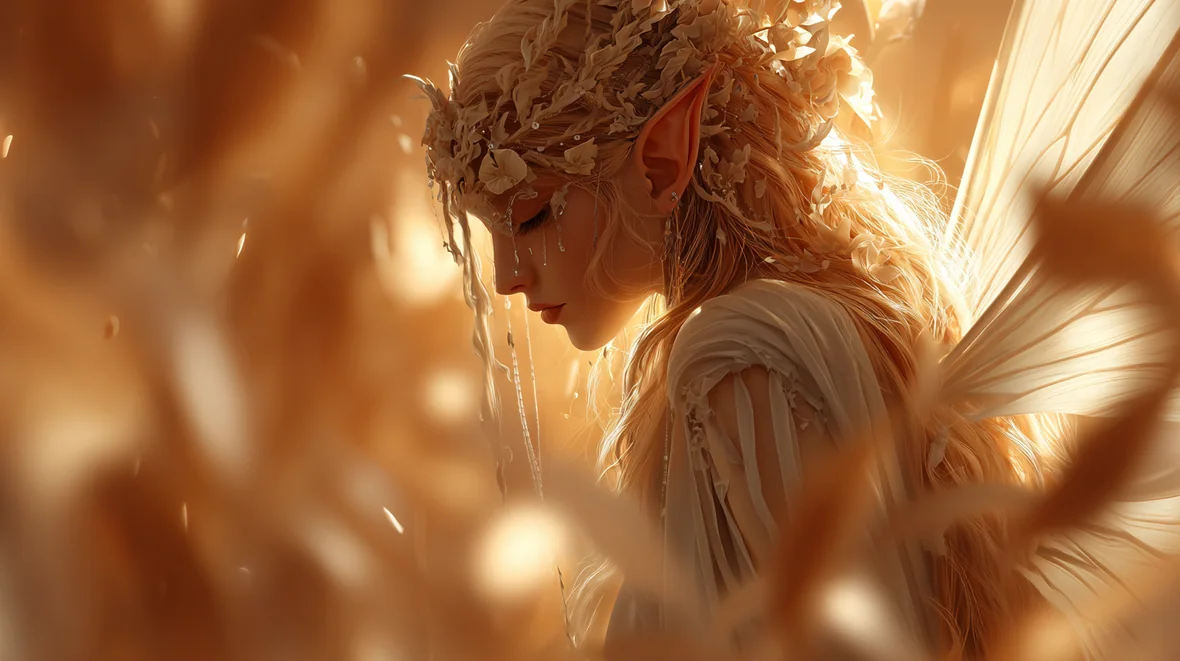
Áine: Eternal Light & Ancient Flame draws artistically on light, summer, landscape, sovereignty, and seasonal renewal. Its golden atmosphere is a deliberate contemporary response to Áine’s traditions, not evidence that those traditions had one fixed solar meaning.
The difference leaves room for both research and imagination. A song can choose one mood without claiming to contain an entire figure. Listeners can follow that mood back to the local and literary contexts that complicate it.
Explore Áine: Eternal Light & Ancient Flame, or visit Great Bear Music for the wider musical project.
Sources
Sources and further reading
- Medieval narrative: Cath Maige Mucrama, sections 1–5 and editorial note, Irish Sagas Online, University College Cork
- Place and tribal names: Áine Chliach, Irish Sagas Online, University College Cork
- Place-name evidence: Cnoc Áine / Knockainy, Placenames Database of Ireland
- Medieval place-name poetry: Bend Etair II, stanza 15, The Metrical Dindshenchas, CELT, University College Cork
- Later local folklore: Fairy Forts, Lough Gur, The Schools’ Collection, National Folklore Collection, UCD
- Later local folklore: Áine and Fer Fí, Gráinseach, The Schools’ Collection, National Folklore Collection, UCD
- Historical folklore collection and antiquarian interpretation: W. Y. Evans-Wentz, The Fairy-Faith in Celtic Countries (1911), pp. 79–81 and notes 24–25
- Modern scholarship: Proinsias Mac Cana, Aspects of the Theme of King and Goddess in Irish Literature (1955), opening discussion, p. 76