Who Is the Morrígan?
The Morrígan is a divine figure in Irish mythology whose power is encountered through particular stories, rather than a single catalogue of responsibilities. Calling her a war goddess is reasonable. Calling her only a death goddess loses the differences between threatening a warrior, influencing conflict and speaking about its aftermath.
The sources discussed here are medieval literary witnesses, transmitted and shaped in Christian Ireland. They matter as evidence for the stories that survive; they do not provide a direct survey of worship throughout ancient Ireland.
Nor does “Irish goddess” mean membership of one uniform Celtic pantheon. Different genres, manuscripts and episodes make different demands on a character. The useful question is not simply what she governs, but what her presence changes in each narrative.
Morrígan in the Second Battle of Mag Tuired
In Elizabeth A. Gray’s translation of Cath Maige Tuired, the Dagda meets the Morrígan beside the Unshin. They have a sexual encounter; she then supplies intelligence about the Fomoire and promises destructive action against their king, Indech. The episode associates intimacy with preparation for conflict, without itself giving us a general theory of sacred marriage.
Later, identified as Ernmas’s daughter, she strengthens the Túatha Dé for battle. After victory she announces the outcome to Ireland’s heights, waters and supernatural hosts. The passage then names Badb, a shift worth noticing rather than silently correcting.
She is consequential before, during and after the fighting. Yet reading these actions as a coherent ritual programme requires an argument beyond recounting the episode. A narrative encounter, an act of assistance and a proclamation can illuminate one another without becoming proof of one universal ceremony.
The text’s violence should also remain visible. Support for one side brings destruction to another; divine assistance is not necessarily gentle or morally comfortable.
Morrígan and Cú Chulainn
In Táin Bó Cúailnge, Recension I, she approaches Cú Chulainn as a beautiful woman, declares love and offers assistance. He refuses; threats of interference follow. That exchange exists, but reducing their relationship to a rejected lover’s revenge makes a brief encounter explain too much.
During his fight with Lóch she obstructs him in animal forms, and he wounds her. Later, disguised as an old woman milking a cow, she receives healing through drinks of milk and his blessings. His retrospective refusal to have helped her knowingly preserves their antagonism.
The Book of Leinster account arranges the animal interventions differently and invokes an earlier threat in the Foray of Regamain. These are related textual traditions, not identical scenes that can be merged without explanation.
Hostility, vulnerability and the binding force of speech coexist here. Reading the encounters as tests of heroic power is an interpretation; it should not erase their concrete exchanges or pretend the goddess controls everything without resistance.
Transformation and Animal Forms
The eel, wolf and heifer are securely grounded in the Táin episodes. Even their details vary: Recension I gives a grey she-wolf and red hornless heifer; the Book of Leinster has a russet she-wolf and a white, red-eared heifer.
This variation matters more than choosing a single “correct” animal chart. The forms function within a ford combat, where movement, footing and cattle can alter a warrior’s chances.
Bird imagery needs equal care. Gwynn’s translation of Odras calls the shapeshifting goddess a raven-caller and identifies her with the Morrígan. This is a real textual bird association, but that wording alone is not a statement that she is always a raven.
Badb’s crow associations, later iconography and modern artistic convention also contribute to the familiar black-bird image. Not every bird in an Irish story names the Morrígan, and a modern illustration cannot identify an unnamed medieval bird for us.
War, Battle and Victory
“War goddess” is useful when it directs attention to the consequences of her actions. It becomes limiting when it substitutes a generic armoured fighter for the stranger ways power operates in these narratives.
Battle includes anticipation, morale, vulnerability, speech and the interpretation of outcomes. A force that threatens the conditions under which a hero can fight belongs to that wider landscape even without behaving like another human champion.
Fear also requires attribution. The Book of Leinster Táin names Nemain as bringing confusion and fatal terror to an army. That episode illuminates the surrounding battle-divinity tradition; it should not simply be reassigned to the Morrígan.
Victory has political consequences as well as military ones. To ask who survives, whose people prevail and what order follows is already to move beyond counting blows. This broader reading makes room for sovereignty questions without treating every reference to war as evidence for kingship ritual.
Sovereignty and Kingship
Sovereignty concerns authority over a territory, legitimate rule and the relationship between a ruler and a community’s wellbeing. Proinsias Mac Cana’s influential study opens by connecting Irish goddess traditions with land and kingship, while recording differing interpretations of that connection.
This provides a comparative framework, not an automatic definition of every divine woman. Applied to the Morrígan, it invites questions about territorial power and the political meaning of victory. It does not prove that each of her appearances bestows a crown.
Scholarship itself needs qualification. Andrew McQuaid’s review of Máire Herbert notes that she considered it too simple to describe the Morrígan merely as a sovereignty goddess. Ronald Hutton goes further in his 2026 lecture, rejecting that classification because she does not actually confer rulership.
Rose Arcane therefore treats sovereignty as an important interpretive question, not an uncontested divine office. The connection with land can be explored while distinguishing a political reading of a story from evidence for an inauguration practice.
Is the Morrígan a Goddess of Death?
The Morrígan is strongly associated with battle, danger, destruction, prophecy and warriors’ fate. These connections explain the death-goddess label, but the surviving stories do not reduce her to Death personified. Victory, transformation, divine relationships and the aftermath of conflict also matter.
The association is incomplete rather than simply mistaken. A presence around violent death need not function as an Irish equivalent of a Grim Reaper, and predicting loss is not the same narrative action as collecting souls.
Nor should every washer-at-the-ford tradition be folded into her biography without checking its named figure and source. A recognisable motif can recur without establishing one identity across every telling. Keeping the distinction makes the death association more precise, rather than removing its seriousness.
Morrígan, Badb, Macha and Nemain
The names overlap without settling into one universal family diagram. The Lebor Gabála Érenn material inspected here groups Badb, Macha and Anand as Ernmas’s daughters; another passage names Morrigu and identifies her as Anand.
The same compilation places Fea and Neman among Néit’s wives, while a later verse gives Badb and Neman. These are differences within a transmitted genealogical dossier, not a modern chart awaiting one missing label.
Alongside the Morrígan/Badb shift in Cath Maige Tuired, they support reading each grouping in context. “Mór-rígain” and other spellings likewise belong to the textual discussion; spelling alone does not solve identity.
Irish tradition also contains multiple Macha figures. Our Macha page distinguishes kingship, Emain Macha and the coerced race tradition. It should not be read as one continuous biography of every Macha named alongside the Morrígan.
Is the Morrígan a Triple Goddess?
Triadic interpretation has a textual foothold in groupings such as the three daughters of Ernmas. Repetition, kinship and overlapping battle associations make a threefold reading attractive, and help explain its continuing influence.
But grouping three figures is not automatically describing three life stages of one being. The passages examined here do not establish a fixed maiden, mother and crone system for the Morrígan.
A tidy modern diagram can hide different lists, shared names and shifts between individuals and groups. It can also make readers believe that an apparent contradiction must be their mistake, when the sources themselves are not uniform.
Modern religious readers may use a triple-goddess framework meaningfully. Historical description needs a different standard: identify the passage, explain its grouping and mark any further theological synthesis as interpretation. Respect for contemporary practice does not require presenting that synthesis as unchanged medieval doctrine.
Prophecy, Fate and the End of Battle
At the close of Cath Maige Tuired, victory news is followed by a prophecy of future disorder, including failed abundance and social wrongdoing. The movement from triumph to threatened collapse prevents the ending from being merely celebratory.
“Fate” on this page describes attention to outcomes, warnings and the precarious future. It does not claim that the texts supply a complete doctrine in which every event is predetermined by one goddess.
The Book of Leinster Táin also places her on a pillar-stone warning Donn Cúailnge about the approaching army. Foreknowledge reaches beyond an individual duel.
There is a difference between knowing danger, announcing it and causing it. Preserving that distinction allows prophecy to remain powerful without making every warning an act of killing. The end of battle can establish a present victory while leaving the future unsettled.
The Morrígan in Modern Interpretation
Modern readers and artists may explore female autonomy, shadow, confrontation with mortality or power outside ordinary social expectations through the Morrígan. These are interpretive possibilities, not a recovered medieval doctrine.
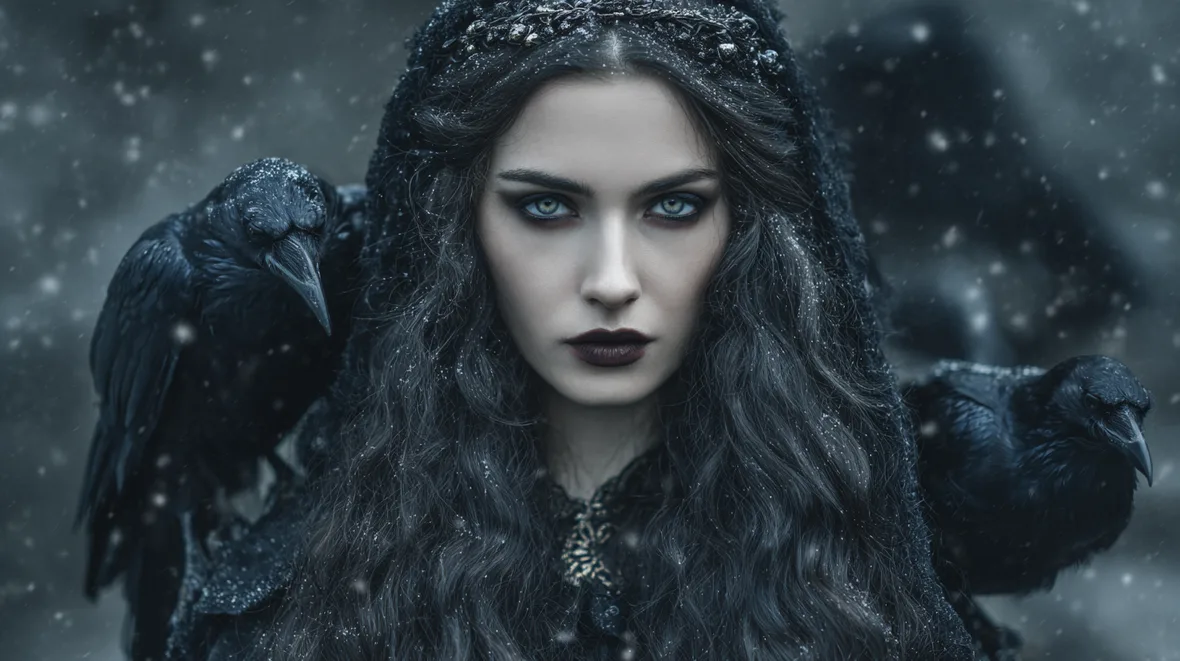
A contemporary portrait can emphasise storm, birds or darkness; an essay can attend instead to voice, refusal, transformation or responsibility. Each selection brings some features forward and leaves others behind.
The editorial task is to name that selection. A modern image should not become evidence that medieval audiences always imagined the same clothing, temperament or symbolism. Equally, source criticism need not demand that art reproduce a manuscript sentence literally.
The strongest dialogue between past and present keeps both visible: the particular literary episode and the new question someone brings to it.
The Morrígan in Rose Arcane and Great Bear Music
These stories offer material for contemporary music about battle, sovereignty, fate and transformation. Within Rose Arcane, that artistic direction belongs alongside Great Bear Music, while remaining distinct from historical explanation.
A musical response can explore the tension between threatening speech and vulnerable bodies without claiming to reconstruct an ancient rite or musical tradition.
Sources and Interpretation
The sources below distinguish medieval texts in scholarly translation, a genealogical compilation, a general sovereignty framework, a review of scholarship and a contemporary academic lecture. Recensions remain distinct.
Translations also contain editorial decisions and acknowledged gaps. A fluent modern paraphrase should not conceal uncertainty where the edition marks it. Literary evidence supports a nuanced divine figure; it does not establish universal worship across ancient Ireland.
Explore Next
Follow these routes as comparisons and context, rather than interchangeable categories:
- Explore Celtic Mythology
- Explore Celtic Goddesses
- Explore Women Warriors in Celtic Mythology — compare martial women with battle-associated divine figures.
- Read Macha — several Irish traditions share this name.
- Read Áine — a different regional and sovereignty context.
- What We Mean by “Celtic Mythology”
- Explore Great Bear Music