Celtic mythology topic hub

Women Warriors in Celtic Mythology

Women warriors in Celtic mythology are not one fixed archetype. In the medieval Irish material most relevant to the current Rose Arcane collection, female figures may appear as martial teachers, rivals, queens, sovereignty figures, legendary fighters, mothers, or keepers of difficult thresholds.

The safest way to read them is source by source. Scáthach, Aífe, Medb, and Macha do not all do the same narrative work, and none should be collapsed into a generic "Celtic warrior goddess" label without evidence.

Source-aware definition

What counts as a woman warrior?

"Women warriors" is a useful modern search phrase, but it is not a medieval category with one stable meaning. It can point toward women who train heroes, women who fight, queens who direct war, figures whose authority is tied to sovereignty, and characters whose power is expressed through challenge, boundary crossing, or ordeal.

Celtic mythology is also a modern umbrella. Rose Arcane uses it carefully, especially for medieval Irish stories connected with the Ulster Cycle. This page therefore emphasizes Irish literary examples that can be discussed responsibly from surviving sources, while acknowledging that other Celtic-language traditions have their own contexts.

Read what Rose Arcane means by Celtic mythology

Published figure

Scáthach, martial teacher at the edge

Scáthach is the current published Rose Arcane example of a Celtic warrior-teacher figure.

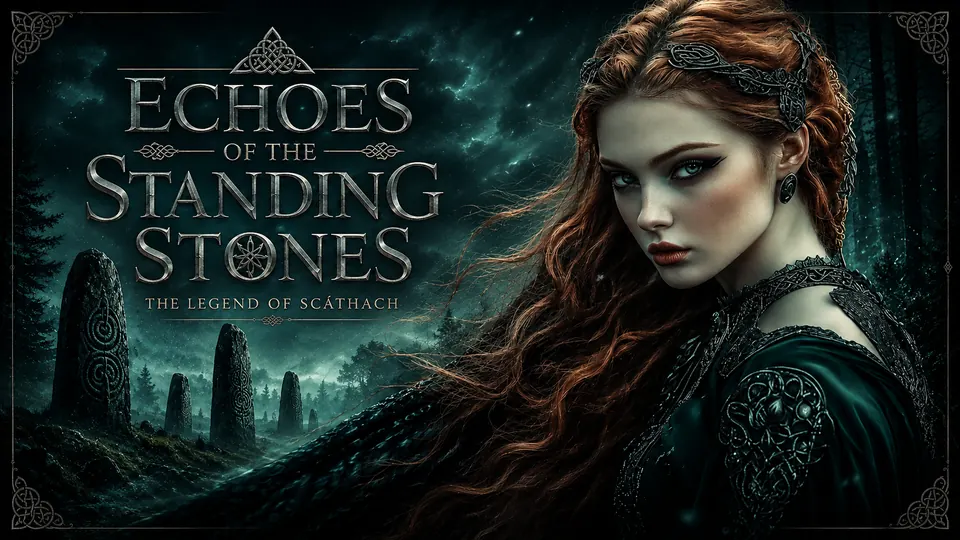
Related album artwork for Echoes of the Standing Stones, shown with the Scáthach story page.

Legendary woman; warrior teacher; Ulster Cycle figure

Scáthach

Scáthach is a legendary warrior teacher in medieval Irish tradition, remembered especially through stories of Cú Chulainn's training, ordeal, and transformation.

The surviving material does not give a single settled biography. Medieval literary episodes, later geographic associations, folklore, and modern reinterpretations should be kept distinct.

In the Cú Chulainn training traditions preserved through texts such as The Training of Cú Chulainn and The Wooing of Emer, Scáthach's importance is pedagogical and initiatory. She is dangerous because she holds knowledge, terrain, and tests that ordinary heroic society cannot provide.

Training, rivalry and ordeal

Teachers and challengers are not interchangeable

Scáthach and Aífe are often remembered together because they appear in the wider Cú Chulainn training world. The narrative logic matters. Scáthach is associated with instruction, dangerous thresholds, and the transmission of feats. Aífe appears as a formidable rival and combatant, sometimes set against Scáthach and then drawn into Cú Chulainn's own story.

These roles are martial, but they are not identical. A woman who fights, a woman who teaches fighting, and a woman who represents a heroic ordeal may all belong to a warrior landscape without being the same type of figure. That distinction helps preserve the strangeness and texture of the stories.

It also prevents a common modern flattening. The phrase "warrior woman" can illuminate a pattern of female martial authority, but it should not erase literary function, source date, manuscript context, or the difference between medieval narrative and later retelling.

Queens, rulers and command

Women in war are not always fighters in armour

Medieval Irish literature also presents women whose relationship to war is political or sovereign rather than simply physical combat. Medb of Connacht, for example, belongs to the narrative world of Táin Bó Cúailnge, where armies, negotiations, rivalries, and challenges move around queenly power. Her role cannot be reduced to a battlefield pose.

Macha offers another important caution. The published Rose Arcane Macha page treats Macha as a layered name moving across traditions of sovereignty, Emain Macha, horses, public ordeal, childbirth, vengeance, war, and place-name lore. Macha Mong Ruad in particular belongs to legendary kingship tradition, where authority, rule, and force are central.

The shared point is not that all these figures are the same. It is that Celtic and Irish legendary materials can give women consequential authority over training, war, land, rule, and heroic reputation.

Read Macha

Themes to track

Five ways the warrior-woman theme appears

These themes are guideposts, not a universal system of correspondences.

Martial Teaching

Scáthach belongs first to a literary world of training, ordeal, specialist knowledge, and heroic formation rather than to a simple goddess category.

Queens and Command

Some narratives give women political or military authority, but queenly command, sovereignty, and combat should be read through each specific source.

Rivalry and Testing

Aífe and other fighting women can function as challengers, rivals, or threshold figures whose episodes test the hero and the story world around him.

Sovereignty and Place

Macha traditions connect force, rule, Emain Macha, horses, land, and public ordeal without reducing every Macha strand to one biography.

Modern Reimagining

Great Bear Music responds creatively to these traditions while keeping modern symbolism separate from medieval evidence.

A necessary distinction

Warrior women should not automatically be called goddesses

Modern readers often reach for the phrase "warrior goddess" because it feels powerful and immediately legible. Sometimes that language may be appropriate, depending on the figure and source. But it is not safe as a default.

Scáthach is the clearest example on Rose Arcane. She is a legendary woman and warrior teacher associated with the Ulster Cycle; the site deliberately does not present her as a goddess. Macha, by contrast, belongs to goddess-related and sovereignty traditions, but even her material needs careful separation between different Macha figures and story strands.

The Celtic Goddesses hub handles the related divine and sovereignty category, while this page follows the martial and political theme. The overlap is real, but the boundary matters.

Explore Celtic Goddesses

Literature, memory and history

Legendary women are not direct social history

These stories can feel vivid enough to tempt simple historical claims: Celtic women fought like this, ruled like this, trained heroes like this. Rose Arcane avoids that shortcut. Medieval narrative can preserve cultural imagination, learned literary shaping, inherited motifs, political memory, place-name explanation, and entertainment at once.

That does not make the figures less valuable. It makes them more interesting. A source-aware reading asks what a text is doing: initiating a hero, explaining a place, testing kingship, staging a public wrong, praising courage, or warning that power has consequences.

The point is not to drain the stories of mystery. It is to give the mystery a better frame.

Great Bear Music

Music shaped by training, sovereignty and ordeal

Great Bear Music creates original modern work inspired by old stories. It is not a reconstruction of ancient Celtic music.

Great Bear Music / Music project in development

The Red Mare of Emain

An in-progress Great Bear Music project for Macha within Rose Arcane's modern twelve-figure Celtic series.

This Macha-inspired project remains in development. Rose Arcane does not list invented tracks or listening links.

Explore the project
Explore Great Bear Music

Sources and method

How this page stays source-aware

This hub relies on the published Rose Arcane figure and album records, plus medieval Irish source material made available through institutional projects such as CELT at University College Cork. It keeps medieval texts, later folklore, scholarly uncertainty, and modern Rose Arcane interpretation in separate lanes.

The page does not publish new profiles for Aífe, Medb, or Macha Mong Ruad. They are mentioned only as source-aware examples inside the topic discussion.